
Separate the Colbert County Property Value Types
Alabama treats appraisal and assessment as separate steps. So the county parcel summary lists several value fields. A deed or validation record, when it shows a sale amount, comes from a different source and a different date entirely.
| Value | What It Is | Where |
|---|---|---|
| Total appraised value | The Revenue estimate before applying the assessment class | Parcel summary for a selected year |
| Total taxable value | The value shown after applicable valuation treatment | Parcel summary |
| Assessment value | The tax base produced by the statutory assessment percentage | Parcel summary |
| Last sale consideration | The amount or language stated for a recorded transfer, when disclosed | Recorded deed and validation material |
| Land and improvement values | The county's separate components for the site and structures | Assessment detail |
Assessment value is not a sale price. The class ratio converts the appraised figure into it. A deed's stated consideration, likewise, may reflect a different date, a different property interest, or a transfer outside the open market.
An Industrial Parcel Shows Colbert's Value Math
One inspected parcel shows the math. It covers 82.45 industrial acres. Land value was $396,800. Improvement value ran $848,500, and together the components totaled $1,245,300 in appraised and taxable value while the assessment value came to $249,060. That 20 percent relationship matches the county's Class 2 guidance for commercial and other property, and the Revenue parcel summary displays the full valuation and annual-history context.
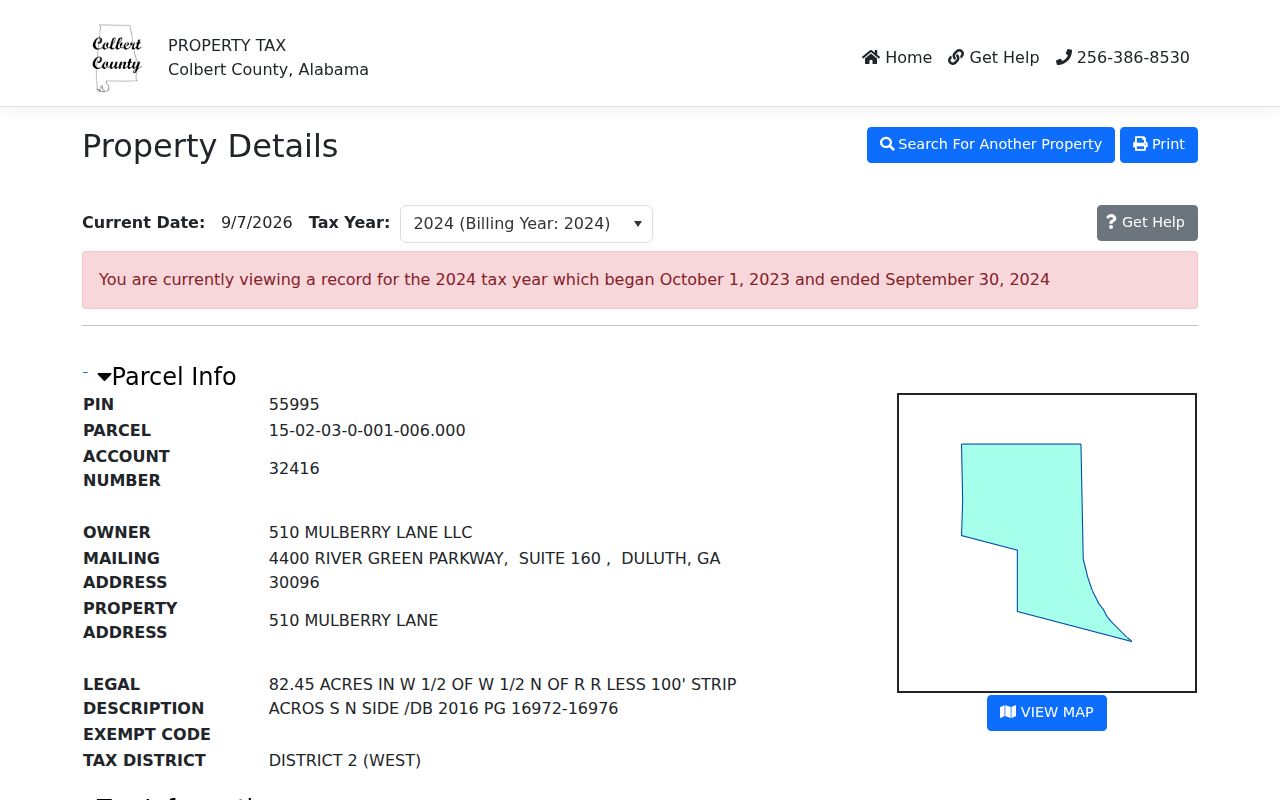
The example explains field relationships on one record. It does not establish a countywide market trend or the right ratio for any other parcel.
Colbert Property Values Depend on Assessment Class
The Revenue Commissioner property-tax explanation sets out the class ratios. Class 1 utility property is taxed at 30 percent. Class 2 commercial and other property sits at 20 percent. Class 3 owner-occupied residential and farm property sits at 10 percent. Verify classification for the parcel and year. Do not infer it from an address or appearance.
- Appraised value
- The county's fair and reasonable market-value estimate under state guidelines.
- Assessment ratio
- The class percentage applied to appraised value to reach assessment value.
- Assessment value
- The resulting tax base before millage and eligible exemptions are applied.
- Reappraisal
- The annual review process that can change the county's value fields.
Classification and exemptions shape taxable outcomes. The county can still update its appraisal of the property's full value in the meantime.
Locate a Colbert County Assessed Value
The county assessment search takes Name, PIN, Company, Parcel, Account, Subdivision, and Address entries. Address is convenient. PIN or parcel is stronger. A situs can be blank, show 0, or format unexpectedly, and those quirks weaken an address lookup.
- Select the tax year and search by the most stable identifier available.
- Confirm PIN, parcel, account, property address, owner, and legal description.
- Copy land, improvement, appraised, taxable, assessment, and use-value fields under their exact labels.
- For sale evidence, inspect the recorded deed and applicable validation material rather than guessing from tax data.
Note the year you select. Annual history differs by parcel, and sample series ran from 2014 to 2026, which does not prove uniform coverage for every account.
Recorded Sale Price Is a Separate Colbert Value
The assessor summaries show no last-sale field. To study a transfer price, take the Probate land-record route instead. Read the deed. Read any transfer or validation material too. Never derive consideration from deed tax, mortgage tax, appraised value, or an assessment amount.
A family transfer, estate conveyance, quitclaim, partial-interest transfer, or corrective deed can also make stated consideration a poor comparison with an open-market sale. Match the transfer date, deed type, parties, and full legal description. Do this before treating it as value evidence.
Note: The public assessment samples did not display a standalone last-sale amount, so deed review is the documented fallback.
Land, Buildings, and Use Value Move Differently
Colbert summaries split land from improvements. Some add use value. Building detail, acres, and property type may appear as well. New construction, demolition, an acreage change, or a use change can move the parts differently, so the total needs its component history rather than one headline number.
Current-use treatment may apply to qualifying farmland, pasture, or timber producing for sale. It adjusts assessed value only. Eligibility and filing rules govern it. A displayed use value does not claim the land could only sell for that figure, so confirm qualification through the Revenue FAQ and office.
Annual Review and the Seven-Percent Colbert Cap
The Alabama Department of Revenue calls for annual reappraisal of real property. Act 2024-344 guidance adds a cap. Increases in taxable assessed value for qualifying existing Class II and Class III real property are capped at 7 percent a year. The cap uses October 1, 2024 as its base and starts with collections on October 1, 2025.
The cap does not freeze fair-market appraisal. Ownership changes can create exceptions. So can a classification change. New improvements, property not previously assessed, and other listed conditions also qualify, so compare annual rows and ask Revenue which event explains a change rather than assuming the cap was applied incorrectly.
Exemptions Alter Taxable Colbert Values, Not Market Evidence
The county material describes H1 for qualifying owner-occupied single-family property, along with age, disability, income-tested, and current-use categories. A sample parcel displayed H1. That proves the code is a useful field, not that another owner qualifies or that an exempt parcel sells for less.
Keep three values separate in notes. Appraised value comes before the class ratio. Assessment value follows it. The taxable result comes after any applicable treatment, and questions about the actual bill, eligibility, or appeal process belong in the Colbert County property tax records guide.
Know the Limits of a Colbert County Property Value
The Revenue Commissioner sets appraised value at fair and reasonable market value. The appraisal follows Alabama Department of Revenue guidelines and the image of a willing buyer and seller. Still, treat the roll as an administrative figure built for tax work. It is not a sale forecast. It is not a survey, title opinion, or inspection. And it is no substitute for a private appraisal prepared for a specific transaction.
One parcel's value history cannot be stretched into a citywide trend either. An exempt parcel, a new improvement, a current-use tract, or an odd industrial site can move the numbers for its own reasons. A simple ownership change can do the same. Those reasons never reach the property next door. So whenever a Colbert County property value is quoted, name the parcel and the tax year. Also name the field label and the source.
Assessment is not an offer. A Colbert County assessed value supports taxation and does not establish what the property would sell for. It is not a private appraisal.