
Colbert's Owner-of-Record Card
The Revenue Commissioner property system lists the owner in a field labeled OWNER. The same summary supplies the tax year and several parcel identifiers. Treat it as one record card, and never turn a blank value into a claim.
| OWNER | Name or entity on the selected assessment roll. |
|---|---|
| PIN / parcel / account | Separate keys used to hold the match together. |
| Mailing address | Destination for tax notices, not proof of residence. |
| Property address | The situs field, which can be blank or 0. |
| Legal description | Lot, block, subdivision, acreage, or section clues. |
| Book/page and history | Leads for deed confirmation and past roll entries. |
The name on the tax roll is a tax fact, nothing more. It does not tell you who occupies the parcel. A mailing address can be the strongest public contact clue the assessor offers. Still, an LLC may receive mail through an agent. An individual owner may get notices somewhere other than the property.
Colbert's October 1 Owner
Ownership status on October 1 controls the tax year, according to the Revenue FAQ. A qualifying buyer must record the deed, assess the parcel, and claim any applicable exemption by December 31. That calendar explains a common puzzle. The owner of record on a tax page can stay unchanged well after a closing. Colbert County publishes no average refresh delay. Keep the tax year, deed date, and recording date separate in your notes. A precise record of any mismatch beats a guessed update window.
Verify Colbert's Current Owner
A recorded deed is the second source you need. The Judge of Probate Recording Department records Colbert County land instruments. The online route links to INGRecords. When a dynamic search or an older image will not load, public-viewing stations remain available at the courthouse.
- Open the Revenue summary and copy the OWNER field, PIN, parcel, account, legal description, and book/page clue.
- Search Probate for the most recent deed tied to that grantee and land description.
- Compare recording date and grantee against the selected roll year. Report any conflict rather than merging it.
- For an LLC, confirm the exact entity through the state business search.
- Owner of record
- The party named by a specific official record and date.
- Assessment roll
- The county's tax-year record of parcels, owners, and values.
- Situs
- The physical property location, distinct from the mailing address.
- Recording lag
- The unpublished interval between a filed deed and an online roll update.
Newest Deed Beats Roll Timing
The latest recorded grantee can be stronger transfer evidence than an older tax roll. An index hit is still not a title opinion. Read the instrument itself and match the legal description. Book and page references from the Revenue summary can shorten the deed records search. Verify them through Probate. The online host's public text does not list the earliest Colbert County coverage year. It also does not list the current image price. Call Probate Recording at 256-386-8546 when the web index is silent. You can also use the courthouse station. Certified and uncertified copies follow the office's published fee schedule. Note: The Recording Department sits on the bottom floor of the courthouse. The address is 201 North Main Street in Tuscumbia.
Colbert Mailing and Situs Fields
A 510 Mulberry Lane LLC record shows why owner research must preserve both address fields. The parcel covers 82.45 acres of industrial land. Yet the mailing field only shows where the entity receives notices. It is not proof that anyone lives there. A Sheffield sample works the other way. It shows a property address of 0. It keeps parcel 07-08-33-1-010-004.000, the City of Sheffield tax district, and a Block 624 legal description. Even a weak situs field does not break the property search. It still works by PIN, parcel, company, subdivision, or legal description.
Check Colbert Entity Owners
Copy an LLC name from Revenue without shortening it. The Secretary of State entity search can return entity identifiers, status, officers or agents, and scanned filings. Match an entity ID to the deed grantee. Similar names or shared mailing addresses are not enough. A registered agent is a contact role, not automatic proof of personal ownership. Trust and estate labels also demand care. The deed, probate case, or a later conveyance may explain the present legal holder, while the tax roll keeps the assessed parcel on its own annual cycle.
Colbert Roll History Is Limited
Revenue summaries expose annual history. Years differ by parcel. Most fall between 2014 and 2026. That table can show which name appeared in a past tax year. It cannot prove a complete chain of title. The samples do not establish uniform countywide coverage. Use the history to explain a roll change. It can also set a date range for a deed records search. Do not treat it as proof that no other transfer, estate event, correction deed, or recorded interest exists.
Current Owners After Tax Sales
Tax-sale history can display a purchaser and later redemption status. One Muscle Shoals parcel carried a 2023 redeemed entry. Neither the purchaser's appearance nor a warning banner alone establishes the current owner. Check the tax-sale file. Check the redemption proof and any later instrument recorded by Probate. A portal warning opens a branch for more records, not a clear-title conclusion.
See a Colbert Owner Record
The Colbert parcel summary shows the layout that connects an owner name with parcel and tax fields.
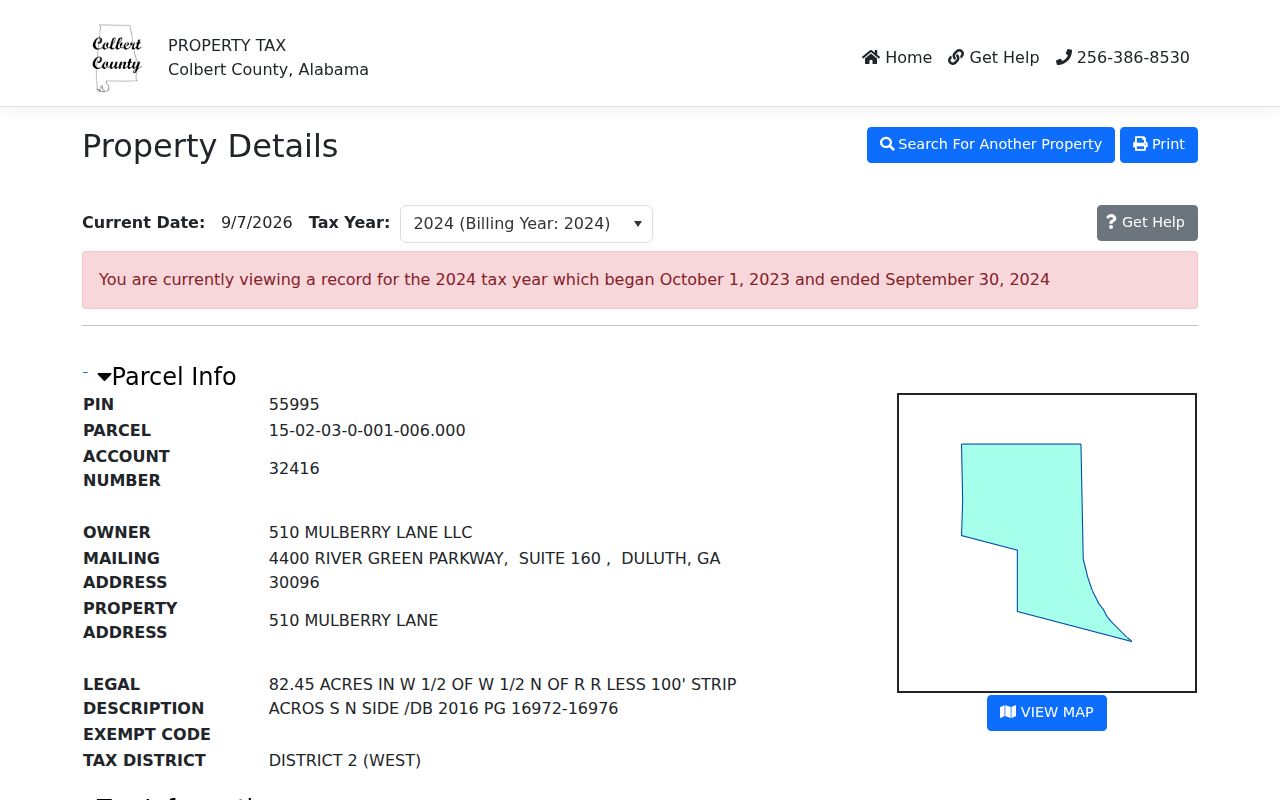
That image is a search example, not a certified owner statement. Check the live record date and the newest deed before relying on the name.
Contact a Colbert Current Owner
The mailing address on the tax roll is official. It is the public clue for a parcel-related letter. State the parcel number, property address, and lawful reason for contact. Never claim the addressee lives there. Returned mail is a gap to report, not grounds to hunt for private details.
Lawful use. A current-owner record supports purchase questions, estate work, and boundary contact. Never use public owner information to harass, threaten, or target anyone.